
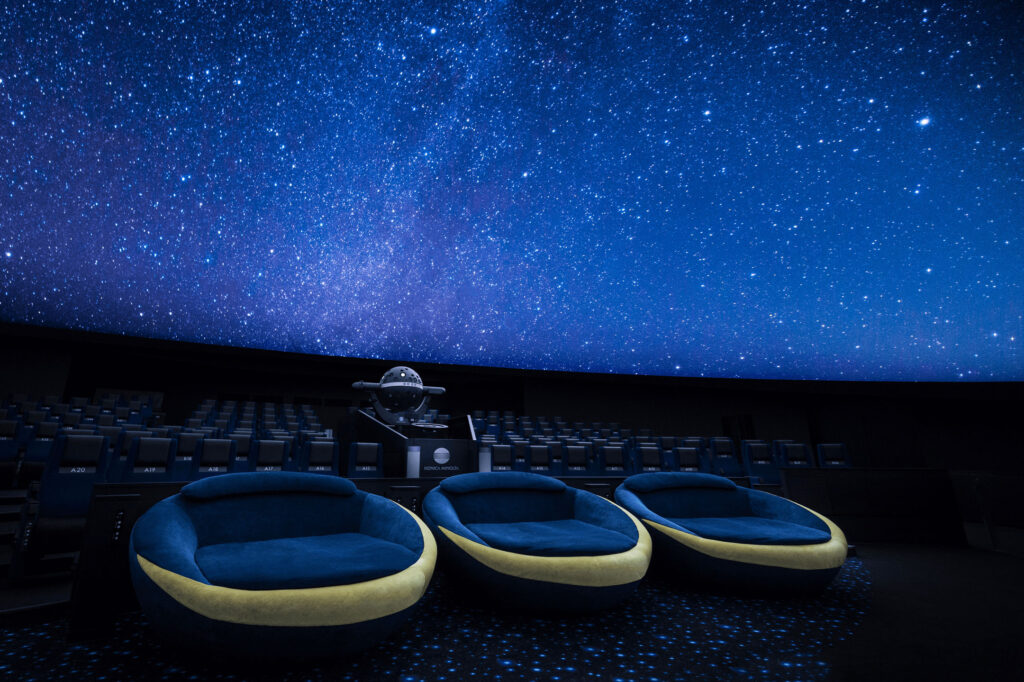
Planetariums have always been fascinating places where audiences can explore the wonders of the universe. While visual elements play a crucial role in creating these experiences, immersive sound systems have become equally important today, adding more depth and realism to the journey through space. Immersive sound in planetariums transforms a planetarium show into an all-encompassing sensory experience, allowing the audience not only to see but also to hear and “feel” the cosmic journey.
Key Features of Immersive Sound for Planetariums
The development of 3D audio for planetariums has made remarkable progress. Organizations like the Immersive Audio Committee of the International Planetarium Society have proposed technical specifications to serve as guidelines for implementing sound systems with maximum impact:
1. Pristine Sound Reproduction
One of the top priorities is the reproduction of crystal-clear sound throughout the entire space. Due to their dome shape, planetariums often have complex acoustics, and it is crucial that every audience member hears the same level of detail, regardless of their seating position. There should be no discernible "sweet spot" in the room; every seat should offer an equivalent sound experience.
2. Low-Noise Design
A low-noise system means that a planetarium sound setup should operate without unintended sounds or distortions, ensuring a quiet and undisturbed listening environment. This is crucial in planetariums, where subtle soundscapes and quiet moments are just as important as loud, dramatic passages.
3. Scalable Systems for an Immersive Sound Experience
Not every planetarium has the budget for large sound systems, so scalability is key. The immersive sound system should be able to deliver a highly engaging experience with a minimal number of loudspeakers. This ensures that even smaller planetariums can provide first-class sound without excessive costs.
4. Integration with Various Projection Systems
Flexibility is a cornerstone of the proposed specifications. The sound system must seamlessly integrate with a variety of projection systems, utilizing a brand-independent range of loudspeakers. This allows planetariums with varying budgets and technical equipment to create an impressive audio experience without being tied to proprietary solutions.
5. Compatibility with Diverse Audio Formats
Immersive planetarium sound systems should be versatile, capable of converting and playing audio in various formats, from mono and stereo to surround sound. This flexibility ensures that existing audio content can be adapted for immersive experiences without requiring extensive post-processing or new recordings.
6. Minimal Latency for Live Events
Planetariums frequently host live lectures, musical performances, or interactive events. To maintain audience engagement, it is crucial that the immersive sound system allows for live audio with minimal latency. This ensures that the sound is synchronized with the visual elements, making live performances feel natural and responsive.
7. 3D Sound Positioning, Movement, and Size
In an immersive system, sound is not just about direction, but also about movement and size. In a 3D space, sound objects can be dynamically moved, creating the impression that sounds are flying through the dome. Even more impressively, sounds can have a 3D "size," conveying a sense of how far away or close a sound source is. This is particularly effective for depicting large celestial events like supernovae or the movement of planets.
8. Scalable Workflow and AR/VR Compatibility
The system should be scalable in terms of workflow and account for the increasing overlap of planetariums with Augmented Reality (AR) and Virtual Reality (VR). This flexibility allows planetariums to remain leaders in technology adoption and offer more diverse, interactive experiences to the audience.
9. Careful Acoustic Planning
The seating positions, the building materials used in the dome, and the overall acoustics of the space must be carefully considered. The immersive sound system can only unleash its full potential if these factors are properly evaluated and aligned with the technology being used.
Summary
Immersive sound systems in planetariums are no longer a luxury – they are essential for delivering captivating and realistic experiences. If the proposed specifications are followed, planetariums of all sizes can create unforgettable audio experiences that complement visual impressions and immerse audiences in the mysteries of the cosmos like never before.
You can find our immersive sound experiences for planetariums here.