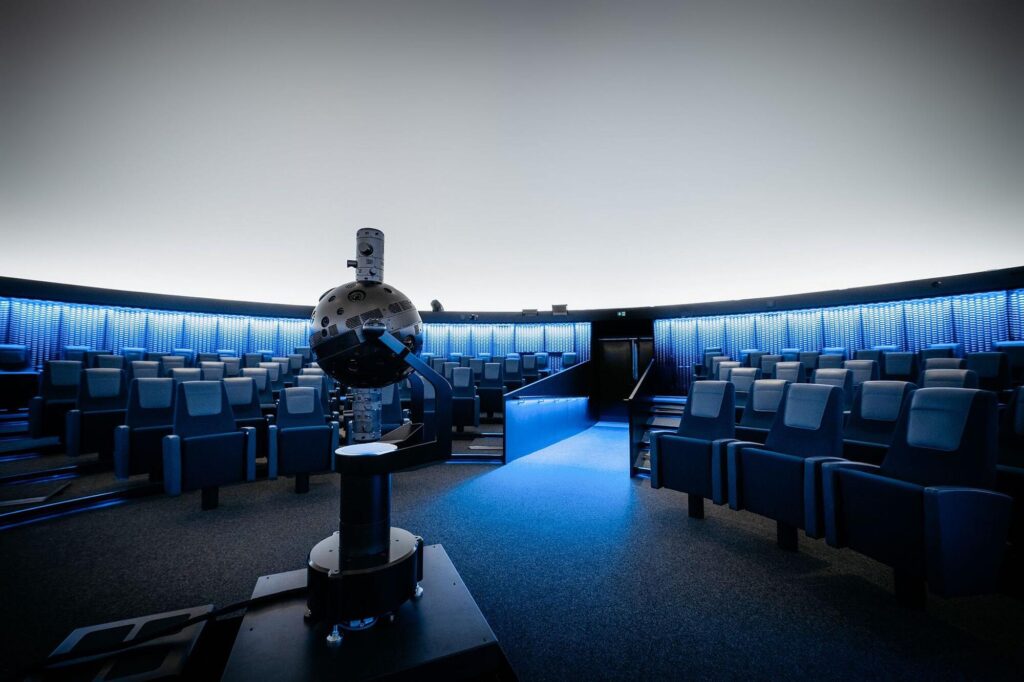
In modern planetariums, sound design and audio play a crucial role in fully immersing the audience in the depiction of the universe. The development of immersive audio technologies like Fraunhofer Spatial Sound Wave (SSW) and other multi-channel systems has revolutionized the experience. A central aspect that significantly influences the listening experience in planetariums is the avoidance of a so-called 'sweet spot' – an optimal listening position. But why is it so important that every visitor, regardless of their seat, has an equivalent acoustic experience?
What is the 'Sweet Spot'?
In traditional stereo or surround sound systems, there is often a 'sweet spot,' the ideal listening area where the sound is perceived as perfectly mixed. Outside this area, acoustic impressions can appear distorted or incomplete. In cinemas and home systems, this is a common problem: the further one moves from the 'sweet spot' (often very central here), the more negatively the sound quality changes.
Planetariums as Ideal Spaces for Immersive Soundscapes
Planetariums fundamentally differ from conventional auditoriums. The dome, which serves as a projection surface for images, creates a 360-degree space that also requires 360-degree sound reproduction. Visitors do not sit in rows facing a stage or screen, but often in a circular or slightly reclined position, oriented towards the entire sky. This is where immersive loudspeaker systems come into play, designed to distribute sound evenly throughout the entire space.
Such systems make it possible to precisely place sound sources in the space, enveloping the entire audience – regardless of where a listener is located. Avoiding a fixed 'sweet spot' means that every seat becomes an optimal listening position. The sound field is designed to unfold organically throughout the entire space, perfectly conveying the acoustic illusion of movement and position in three-dimensional space.
Why is a Sweet Spot-Free Design So Important?
In a planetarium, there isn't one ideal spot to enjoy the best sound experience. Free seating should always guarantee consistently high-quality sound for the audience. This offers several advantages:
- Immersion in the Soundscape: Without a fixed 'sweet spot,' every seat in the planetarium becomes an optimal point to experience the soundscapes. Whether you sit directly in the center or further back – the spatial resolution remains consistently high, enhancing the feeling of immersion.
- Even Distribution of Information: Often, audio elements in planetarium shows are not just atmospheric soundscapes, but also carry important narrative information. To ensure that no one in the audience misses essential information due to a suboptimal seat, the sound must be evenly and clearly distributed throughout the space.
- Enhanced Emotional Impact: Sound plays a crucial role in how we experience emotional moments in audiovisual presentations. A planetarium experience where sound comes from every direction and reaches all seats equally significantly enhances the emotional impact of what is being shown. This allows for a deeper and more holistic experience.
- Flexibility for Organizers and Designers: Without the need to focus on a 'sweet spot,' sound designers have more freedom to use the space creatively. They can place and move sound events impressively within the space, which yields remarkable results, especially in an open and free environment like a planetarium.
Avoiding the "sweet spot" requires careful planning and the use of state-of-the-art technology. This begins with the acoustics of the hall during the construction phase, followed by the use of complex algorithms and sound distribution systems to ensure that sound is not only emitted in all directions but also arrives correctly. Techniques such as wave field synthesis or other highly developed loudspeaker setups contribute to reproducing sound with true 3D spatial depth.
These systems are specifically designed to dynamically adapt the soundscape to the listener's position, ensuring that the sound remains consistently realistic and immersive, even when moving within the space or at the edges of the dome.
Modern planetariums set standards in audiovisual presentation and demonstrate the importance of avoiding fixed "sweet spots." The technology behind these immersive sound experiences may be complex, but the result is effortlessly accessible to the audience: a seamless acoustic environment where every seat is the best seat. Eliminating a "sweet spot" is not just a technical detail but a conscious decision to make the planetarium experience equally impressive for every visitor, regardless of where they are seated.